The post Sustaining Momentum: US Anime Viewership Maintains its Massive 2020 Growth appeared first on Project Anime.
]]>Many genres are pretty stable. Comedy is a genre as old as time – and a genre that does not typically see a lot of growth or contraction among the many folks tuning in for a laugh each week. We saw something similar in our blog post last year.
A more niche genre, like Talk Shows might see more movement. Talk Shows seem to have lost quite a bit of viewership in 2021 compared to 2020.
And, of course, the COVID-19 pandemic means some exceptionally unique movement for certain genres; the massive sports genre saw a massive rebound in 2021 as sporting events return to their regularly scheduled programming (compared to 2020 truncated seasons and canceled events) and fans have more to watch.
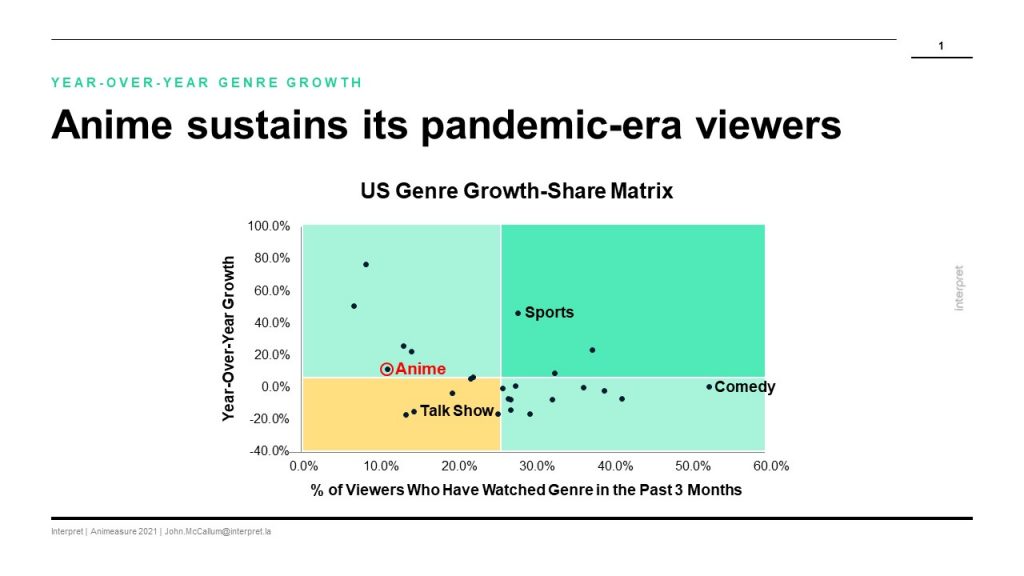
Anime saw massive, market-leading growth in 2020 and continued to grow in 2021. Many analysts assumed that anime’s pandemic-era gains would fade away quickly in 2021, but rather than contracting anime continued to grow (even if at a more modest pace). This US growth in anime viewership comes as global revenues eclipsed Japanese domestic anime revenues for the first time in 2020 (global revenue grew even as domestic revenue in Japan contracted slightly in 2020), suggesting that this trend may continue when 2021 revenue numbers are released.
2021’s continued growth in the US (and other international markets) underscores the need to better understand the steady stream of anime viewers who were not watching anime just a couple years ago.
Given anime’s relatively small market share compared to some other fandom categories (e.g., sports fans), there may remain some who are skeptical around its potential to drive engagement, but next month we will take a look at where anime sits in terms of fan priorities. What do you think – is anime a casual, secondary form of entertainment, or does it drive high-engagement among a passionate fanbase that may make it more valuable than its size alone suggests?
The post Sustaining Momentum: US Anime Viewership Maintains its Massive 2020 Growth appeared first on Project Anime.
]]>The post Esports: Anime Viewers are Tuning In & Cheering On appeared first on Project Anime.
]]>Across markets, many more Anime Viewers watch esports compared to Non-Viewers. In markets including the US, the UK, Germany, and Japan, Anime Viewers are 2x as likely to watch esports as Non-Viewers. Not only do more Anime Viewers watch esports, but on the global level, more support esports and online gaming financially.
As seen in the previous blog post, classic esports genres, like MOBAs, may benefit exceptionally from anime IP, anime-style characters, or animated adaptations that could attract new players, much as League of Legends is doing with the animated series Arcane. Esports juggernauts like League of Legends and Fortnite consistently rise to the top across markets as most-played esports among Anime Viewers.
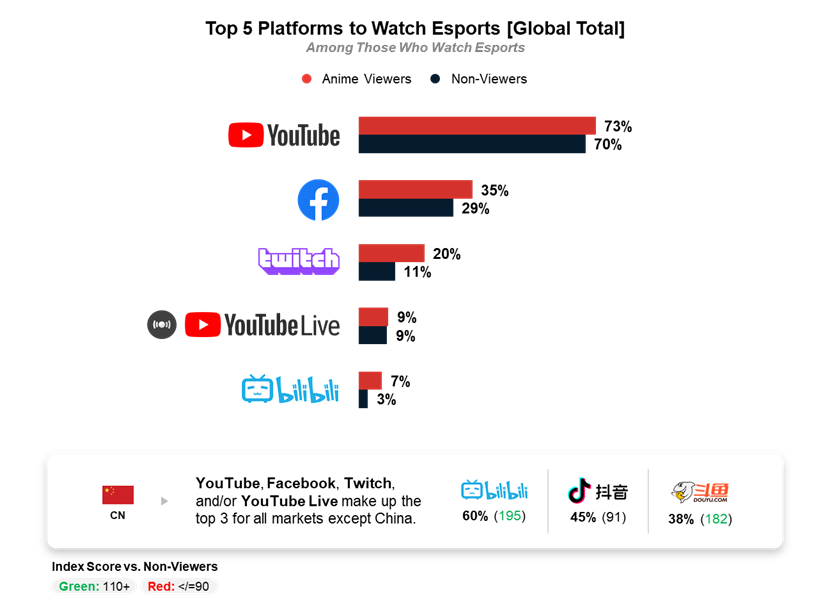
Top platforms for viewing esports such as YouTube and Facebook show relatively little differentiation between Anime Viewers and Non-Viewers, but more tailored sites such as Twitch are far more popular among Anime Viewers compared to their fellow esports viewers who do not regularly watch anime. China, as is often the case, uses its own set of platforms, led by Bilibli.
How have you noticed streamers, esports organizations, and platforms responding to the anime fandom among many esports viewers? What opportunities remain to be explored?
The post Esports: Anime Viewers are Tuning In & Cheering On appeared first on Project Anime.
]]>The post Pushing the Right Buttons: Anime Viewers as Core Gamers appeared first on Project Anime.
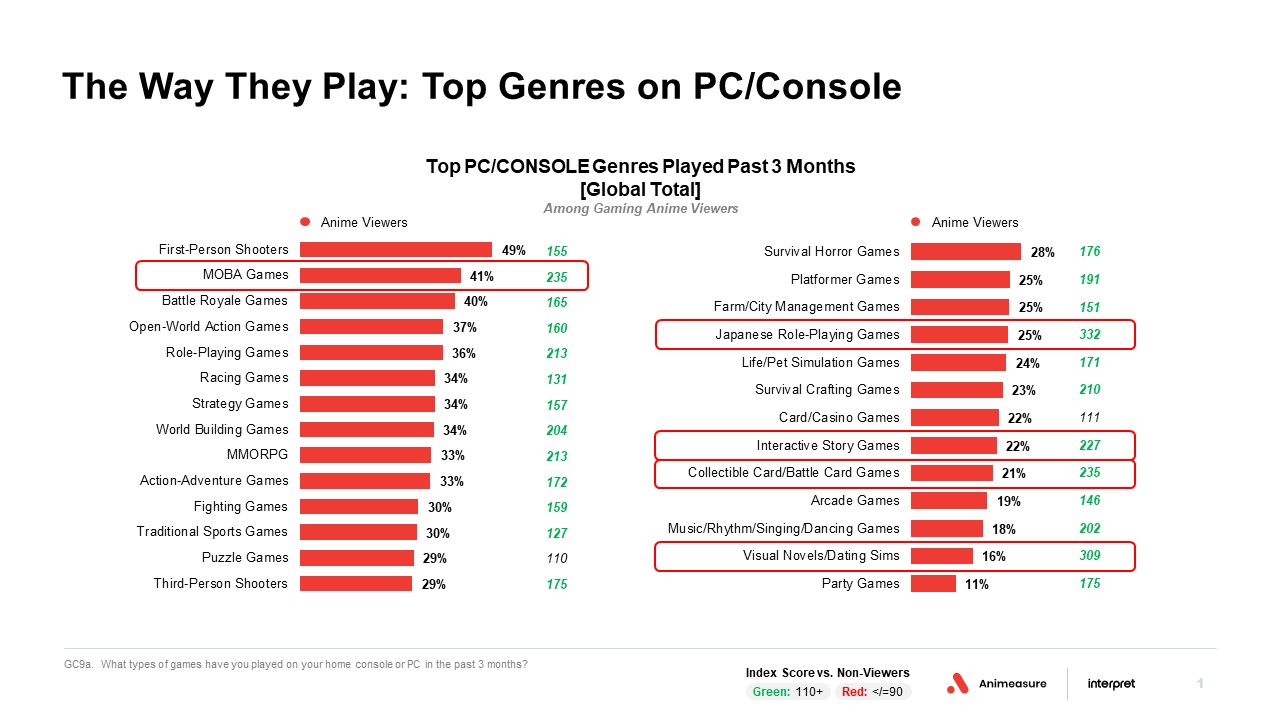
]]>Anime Viewers are far more likely to play video games (Anime Viewers are approximately 1.5x more likely to be weekly PC/Console gamers than Non-Viewers), watch game-related streams/video, and spend more on gaming than Non-Viewers. Anime Viewers play most game genres more than Non-Viewers. But the over-index is especially high for JRPGs, Visual Novels / Dating Sims, Battle Card Games, MOBAs, and Interactive Story games (2-3x more likely to play these genres compared to Non-Viewers).
This will come as little surprise to those familiar with anime’s longstanding “Media Mix” strategy in which beloved characters live across multiple mediums such as both anime and video games. In many ways, these nearly medium agnostic, beloved characters are at the heart of anime’s appeal.
However, there is also a strong overlap among Anime Viewers and game genres that are not so clearly linked to anime – genres such as First-Person Shooters, MOBA games, and Battle Royales. These types of games, all with strong esports scenes, suggest that there are opportunities to compellingly appeal to Anime Viewers beyond anime. In other words, an anime fan convention could serve Anime Viewers with a programming slate that is not exclusively centered around anime-styled video game titles, but that also includes other types of games known to be appealing to this audience.
What has your experience been with the intersection of video games and anime fandom? What are some of the challenges and opportunities that this intersection presents?
The post Pushing the Right Buttons: Anime Viewers as Core Gamers appeared first on Project Anime.
]]>The post What Do Anime Fans Do When They’re Not Watching Anime? Anime & Music appeared first on Project Anime.
]]>For one, anime viewers seem to be music lovers. This may not come as a surprise to AMV fans, but this engagement with music carries implications for music streaming platforms and live events alike.
Looking at their online activity in the US, music streaming platforms such as Spotify or Pandora are far more popular among anime viewers than non-viewers. Spotify is still building out its anime playlists to their fullest potential, having already done the hard work of licensing so many top anime songs to stream on the platform. Spotify sees anime opening and ending tracks crop up in the US Viral Top 50 Chart regularly.
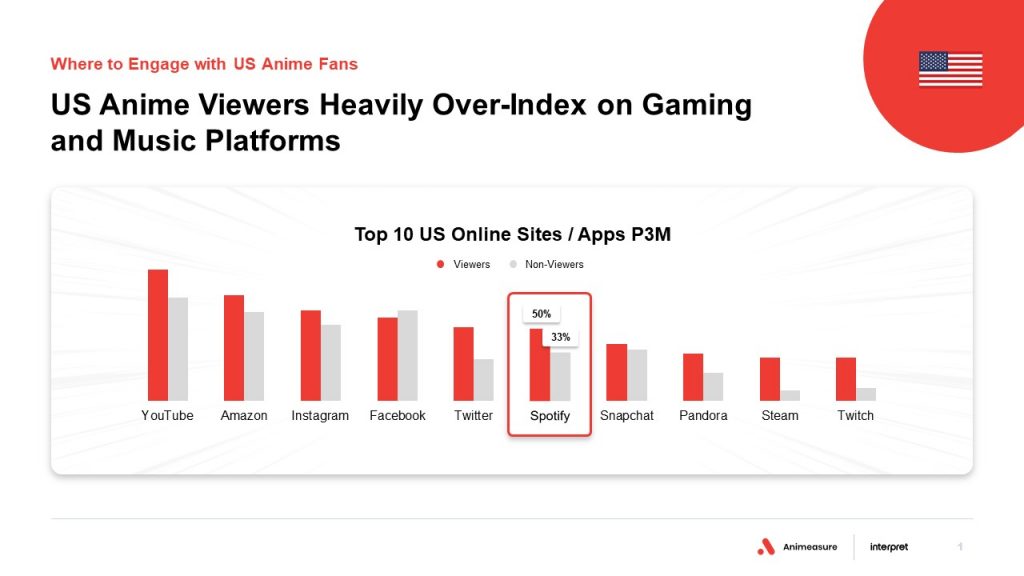
Of course, music streaming platforms like Spotify or Pandora are not the only places where anime viewers over-index. They are also far more likely to be found on Steam or Twitch. In a future blog post, we plan to explore anime viewers as gamers, but Spotify is a great place to find anime viewers and it is also a place where there is a lot of untapped potential.
For event organizers, if a Japanese musical act is coming to perform at your convention—what could you do to circulate a Spotify playlist of the band’s music, to help fans get hyped and anticipate the event? To help them find deep cuts, familiarize themselves with the band’s discography, and enjoy the full-length performance even more? What are ways music streaming platforms could better cater to anime viewers? What other ways could anime viewers’ love of music be leveraged to enhance their experiences as both anime and music fans?
The post What Do Anime Fans Do When They’re Not Watching Anime? Anime & Music appeared first on Project Anime.
]]>The post An Adventurous Shipper and a Princess Walk into a Hot Topic: The Art of Segmentation appeared first on Project Anime.
]]>Interpret has recently completed a segmentation of the anime market, organizing viewers into eight segments to reveal fundamental needs, attitudes, and behaviors common to the clusters within a diverse array of anime viewers. Of these eight, three possess a strong female-identifying skew, and we have coined shorthand terms for each: Princesses, Adventurous Shippers, and Hot Topics.
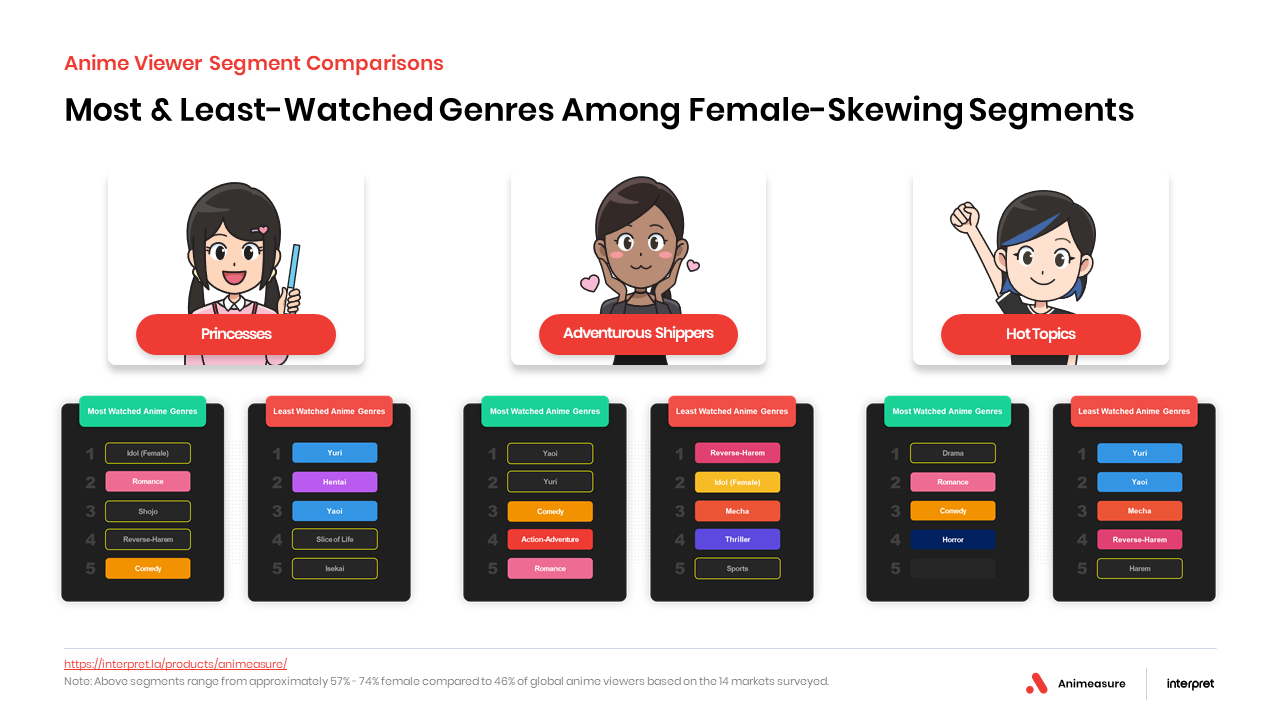
These three segments do not account for all female anime viewers, nor do they fully exclude male-identifying viewers. However, in comparing the viewing habits of these three segments, we realize the extraordinary diversity among female anime viewers who may, on the surface, hold much in common.
For example, all three female-dominated segments report a strong preference for Romance genre anime. When contextualized by their other reported genre preferences, it becomes apparent that the specific driver of this preference may differ dramatically by the segment.
The tongue-in-cheek ‘Princess’ segment is named for the viewer who sees herself as central to the narrative, embodied by a character or serenaded by the onscreen cast. This segment notably raves over Reverse-Harem series, as well as Female-oriented Idol anime featuring charismatic and attractive male leads.
By contrast, Princesses report a strong aversion to the most preferred genres of Adventurous Shippers: Yaoi (Boys’ Love) and Yuri (Girls’ Love). Though both groups overwhelmingly identify as female, we interpret this divergence as being rooted in more than a rejection or acceptance of homoromantic narratives. The Adventurous Shipper preference may be informed in part by a desire for narratives that highlight the relationships of others, without requiring the viewer to identify themselves as the subject of the characters’ affections.
Hot Topics bring a bit of edge to our warm and fuzzy dialogue, citing Romance alongside Drama, Comedy, and Horror as their favorite anime offerings. Unintuitive at first glance, we understand this segment of fans as drawn to powerful anime that elicit strong, cathartic feelings in the storied tradition of body genres (a theory from the world of cinema studies, courtesy of Linda Williams.)
As this analysis shows, the anime genres that segments eschew reveal as much as the genres that they prioritize. The Princess and and Hot Topic segments do not care for Yaoi and Yuri anime. Likewise, Reverse-Harem anime inspire similar disdain among Adventurous Shippers and Hot Topics, implying that neither of these segments neatly align with the Princess ideal. Horror is horrifying to the majority of Princess segment viewers, and elicits a lukewarm response from Adventurous Shippers, but Hot Topic segment viewers keep the heartthrobs, sobs, and screams coming in their entertainment queue, carving out a clear third space for female fandom.
Put another way, all three segments might have tuned in for the climactic final season of Fruits Basket— but while Princesses are cheering on Tohru and Kyo, Adventurous Shippers are tuning in for the non-canon pairings you might not have anticipated, and Hot Topic viewers are vibing with the narrative that combines romance, drama, comedy, and even (spoiler alert!) horror elements.
Perhaps you know someone who resembles one of these data-based profiles. What else might we learn from the viewing habits of a given segment? Which, if any, of these segments do you think best aligns with your anime viewing preferences? How do you conceptualize different segments in the anime audience?
To learn more about Interpret’s anime consumer insights offerings like Animeasure, you can visit our website at: https://interpret.la/products/animeasure/
The post An Adventurous Shipper and a Princess Walk into a Hot Topic: The Art of Segmentation appeared first on Project Anime.
]]>The post Female Fandom & Anime: Uninterested or Underserved? appeared first on Project Anime.
]]>Of all 14 markets surveyed, the US has the smallest fraction of its Anime viewership that identifies as female. Some markets like Vietnam, Russia, and France even see female majorities. In several more, like Korea, China and India, there are nearly even splits.
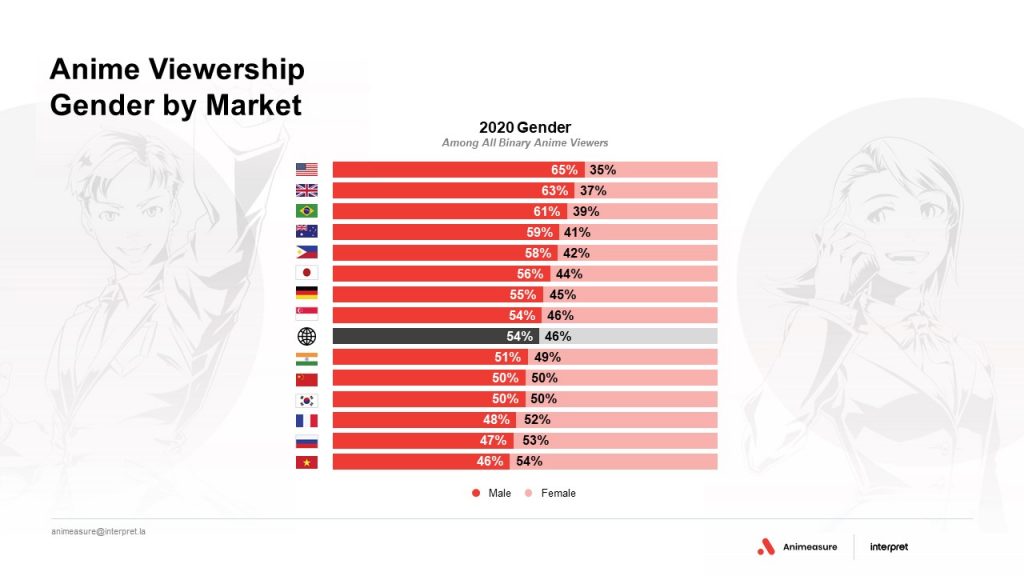
This gender breakdown would likely surprise those in the industry who gauge the anime fanbase at fan conventions. Female viewers consistently show up at conventions and live events, with 40-50% or more of convention attendees at many major anime fan conventions in the US identifying as female. Female viewers are engaged, valuable members of the core anime fandom, yet they do not see the same parity in the broader anime viewership, suggesting the American gender gap is greatest among a more casual, mainstream anime audience.
With such high female viewership in other comparable markets, it seems unlikely that anime appeals less to American women and more likely that there is an opportunity to serve and grow this market, a female market with diverse segments of its own.
What other audiences within the broader anime audience have untapped potential? Next month Interpret will continue to delve into how diverse the anime fandom can be.
The post Female Fandom & Anime: Uninterested or Underserved? appeared first on Project Anime.
]]>The post US Genre Preference: How Anime Meets Needs Not Met by Other Media appeared first on Project Anime.
]]>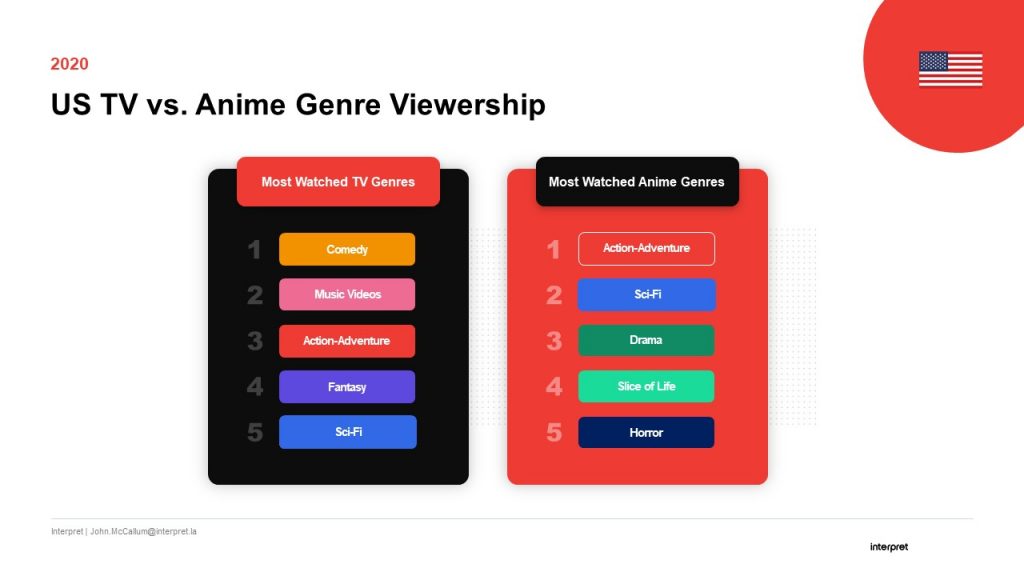
The US is the only market of 14 surveyed that did not rank Comedy in its Top 3 most watched anime genres. In fact, comedy is not even a Top 5 anime genre in the United States. This seems paradoxical—Comedy television among Americans enjoys enduring and overwhelming popularity – it is the #1 most watched TV genre. It would appear, then, that Americans prioritize anime to meet other viewing needs. Why is this the case? Could it be that Japanese comedy is too culturally-specific for American audiences?
That hypothesis, that Japanese comedy is too culturally-specific for an American audience, is suspect. When considering the United States, beyond Action-Adventure and Sci-Fi, the genres rounding out its Top 5 (i.e., Drama, Slice of Life, and Horror) can also be quite culturally specific to Japan. American viewers do not balk at Slice of Life simply because they do not have personal familiarity with every Japanese custom depicted. Then why don’t American anime viewers prefer Japanese comedy as much as viewers in other markets?
Perhaps Americans have a firmer expectation of what an animated comedy looks like. Context counts here. If a domestic market fails to meet a fundamental need, then an audience may be more inclined to look elsewhere to meet that need. But if that need is well-met, and the definition of ‘animated comedy’ has solidified, viewers may feel less inclined to be open to another market’s take on the genre. America is well-known as a producer of acclaimed, comedic animated series and movies – its audience may not feel the need to import them.
But how many America-originated, adult-oriented animated dramas are there? How common are cartoon Slice of Life series on Saturday mornings? When was the last time you watched an animated horror series? Examples that prove the rule exist (some of them inspired by anime), but these genres are rarely explored in Western animation. It suggests that, perhaps, US Anime Viewers are finding needs met in Japanese animation that are not being met currently in Western animation (or even live-action series). American anime viewers do not want for comedic animation, so they do not prioritize looking for it in anime, but if they want something with action, drama, or horror, then anime meets that need.
What are your favorite genres of anime, and how do they compare to your favorite genres of television more broadly? In our next blog post, we will continue thinking about how anime viewership converges with other aspects of entertainment with a focus on esports.
The post US Genre Preference: How Anime Meets Needs Not Met by Other Media appeared first on Project Anime.
]]>The post Anime’s Global Feedback Loop: Understanding the Influence of an International Audience appeared first on Project Anime.
]]>There is now more than ever an anime industry feedback loop running in two directions – anime production is not only influenced by the market you cater to, or the Japanese market alone, but by the preferences and imperatives of a global population of viewers who may decide to tune in.
Anime has received tremendous grassroots support in markets around the world, but in recent decades it has also been promoted by the Japanese government as a key strategic export. Japan’s state-directed push for soft power (cultural rather than economic or military influence), Cool Japan, has worked, but not necessarily the way the government intended. Viewer interest in Japanese culture and media has deepened, but their preferences – shaped by different cultural, linguistic, and lived experiences – were not reshaped entirely by encountering Japanese media. Rather, we see that fans have consistently talked back to the anime industry – and the industry responded in kind.
Today, thanks to the rise of simulcasts, simuldubs, and co-productions, the viewers have greater influence over production than ever before. The resultant media is shaped by preferences expressed by a wide swath of global viewers, not only by the original Japanese audience.
This rising tide of viewer engagement and demand does not necessarily lift all ships equally. When a Japanese consul general donned a Doraemon mask at Sakura-con some years ago, he was surprised to find that the gesture was met with near radio silence. Despite growing awareness of popular titles among the primarily US audience at the convention, they showed minimal awareness of a series that virtually all Japanese children (and many children throughout other Asian markets) encounter at one time or another whether on TV or in merchandise. The same holds true even today.
Like the morning talk show of years past (referenced in last month’s blog post), some programming may become obsolete or remain obscure: “left behind” with one demographic while other titles continue to traverse the globe.
If yesterday’s data might not be able to keep up with today’s diverse anime fandom, then who is the anime viewer of today? Next month, we’ll take a look at some of Interpret’s proprietary data on US anime viewers and their genre preferences to not only get to know Anime viewers better but to learn a bit more about the entertainment needs uniquely met by anime in this market.
The post Anime’s Global Feedback Loop: Understanding the Influence of an International Audience appeared first on Project Anime.
]]>The post Why You May Not Know Your Anime Fans as Well as You Think appeared first on Project Anime.
]]>The vast majority of genres are mostly stable. For example, Comedy is a genre as old as time – and a genre that does not typically see a lot of growth or contraction among the many folks tuning in for a laugh each week. Even with COVID, we seem to maintain our sense of humor. So, a big, dominant genre like Comedy sees little movement.
A more niche genre, like Talk Shows might exhibit more volatility. For whatever reason, Talk Shows are down in 2020 compared to the same quarter in 2019.
But of all the genres we ask about, with most showing little change Year-Over-Year and a couple struggling, only one shows substantial and significant YOY growth: anime. There are two main takeaways from this.
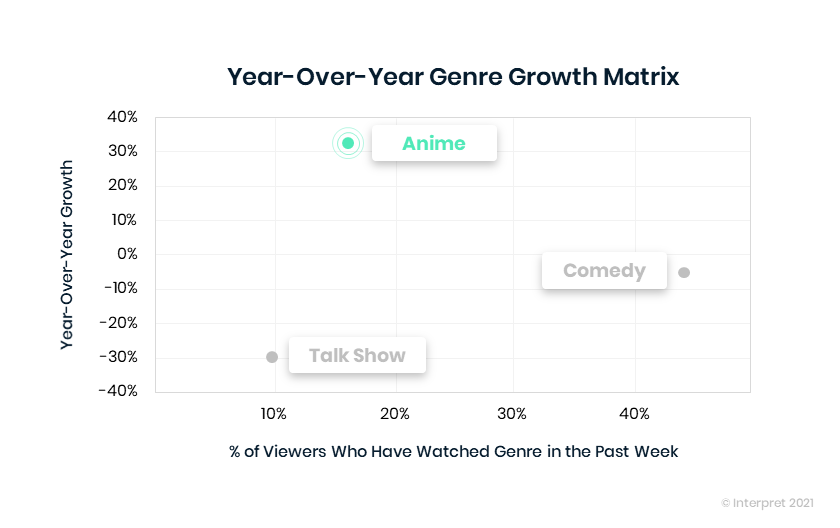
First of all, Anime is doing well here in the United States! Sure, it’s still niche. The greater than 30% growth Interpret sees does represent something like a change from 12% to 16% of US TV/streaming viewers aged 13-44 who watch it weekly. Netflix reports a 50% increase in households watching at least one anime title in 2020. Crunchyroll has added an additional 1 million paid subscribers in about 6 months. Anime is a rising star in the world of niche entertainment.
The second, and more striking, take-away is that fully one-quarter of people watching Anime today were not watching it a year ago. Put another way, if your understanding of the anime fandom is based on research or interactions from 5 years or 3 years or even a year ago, 25% of the Anime Fan population today is made up of people you may not yet know.
2020 has been a challenging year and 2021 has not taken its foot off the pedal yet, but much as the industry must change and grow, newcomers to this space are developing their preferences, viewing habits, and demand for programming in real time, and we should watch closely to see what kind of fan emerges from this rapid period of growth and innovation in fan lifestyles.
The anime fandom is not only rapidly growing, but globalizing. Next month, Interpret will draw on further insights from our 2020 global anime research to offer context for forming a global anime strategy and understanding how global trends impact each and every domestic market.
The post Why You May Not Know Your Anime Fans as Well as You Think appeared first on Project Anime.
]]>