The post Esports: Anime Viewers are Tuning In & Cheering On appeared first on Project Anime.
]]>Across markets, many more Anime Viewers watch esports compared to Non-Viewers. In markets including the US, the UK, Germany, and Japan, Anime Viewers are 2x as likely to watch esports as Non-Viewers. Not only do more Anime Viewers watch esports, but on the global level, more support esports and online gaming financially.
As seen in the previous blog post, classic esports genres, like MOBAs, may benefit exceptionally from anime IP, anime-style characters, or animated adaptations that could attract new players, much as League of Legends is doing with the animated series Arcane. Esports juggernauts like League of Legends and Fortnite consistently rise to the top across markets as most-played esports among Anime Viewers.
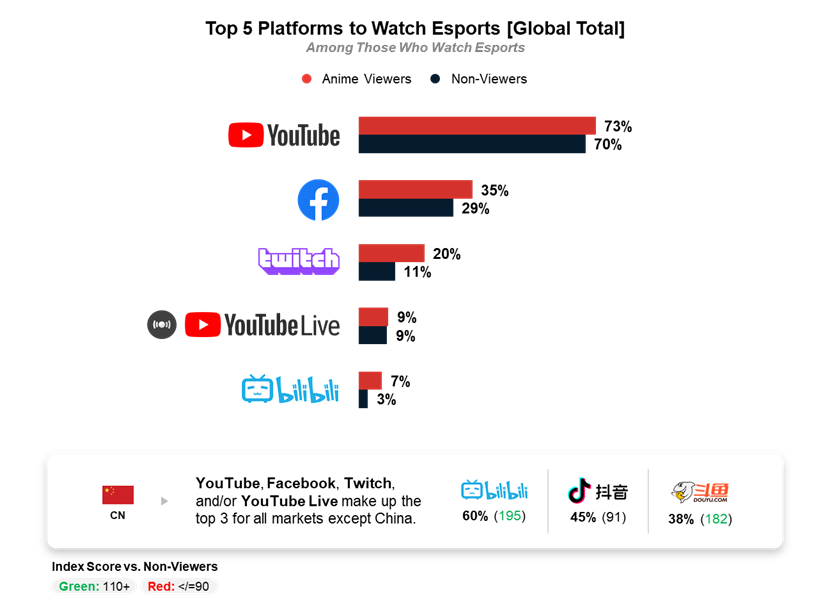
Top platforms for viewing esports such as YouTube and Facebook show relatively little differentiation between Anime Viewers and Non-Viewers, but more tailored sites such as Twitch are far more popular among Anime Viewers compared to their fellow esports viewers who do not regularly watch anime. China, as is often the case, uses its own set of platforms, led by Bilibli.
How have you noticed streamers, esports organizations, and platforms responding to the anime fandom among many esports viewers? What opportunities remain to be explored?
The post Esports: Anime Viewers are Tuning In & Cheering On appeared first on Project Anime.
]]>The post Pushing the Right Buttons: Anime Viewers as Core Gamers appeared first on Project Anime.
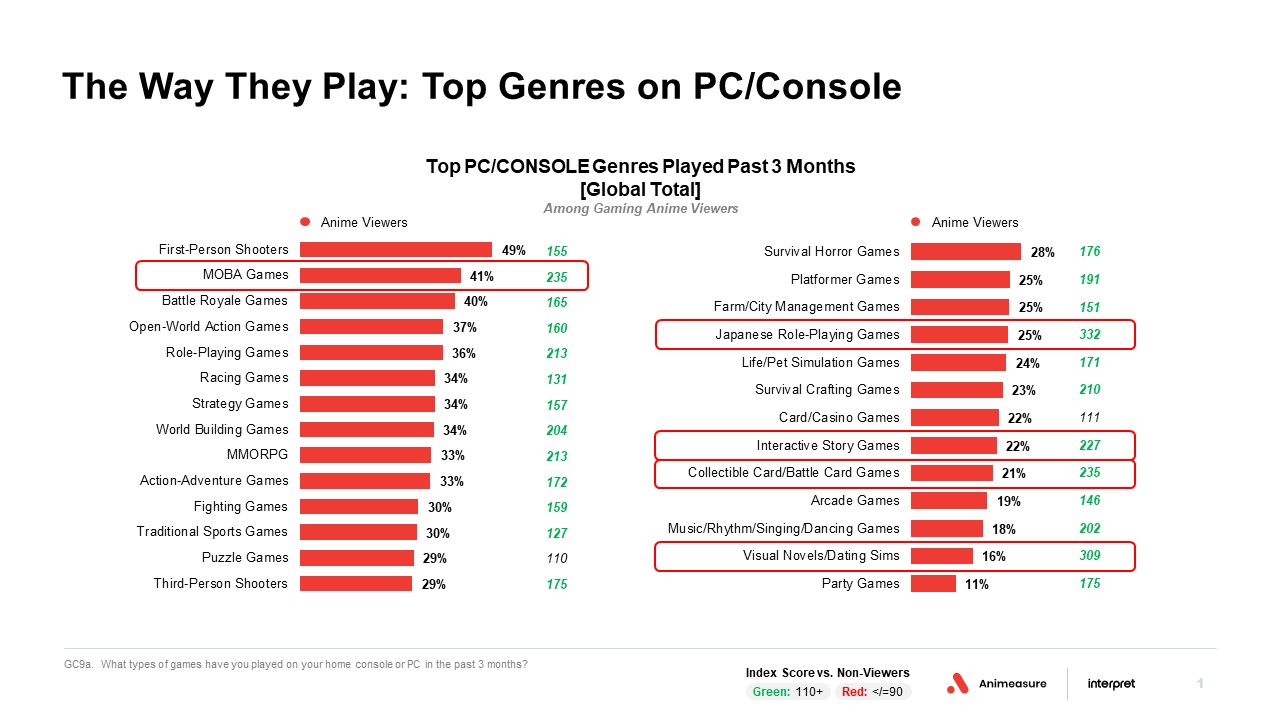
]]>Anime Viewers are far more likely to play video games (Anime Viewers are approximately 1.5x more likely to be weekly PC/Console gamers than Non-Viewers), watch game-related streams/video, and spend more on gaming than Non-Viewers. Anime Viewers play most game genres more than Non-Viewers. But the over-index is especially high for JRPGs, Visual Novels / Dating Sims, Battle Card Games, MOBAs, and Interactive Story games (2-3x more likely to play these genres compared to Non-Viewers).
This will come as little surprise to those familiar with anime’s longstanding “Media Mix” strategy in which beloved characters live across multiple mediums such as both anime and video games. In many ways, these nearly medium agnostic, beloved characters are at the heart of anime’s appeal.
However, there is also a strong overlap among Anime Viewers and game genres that are not so clearly linked to anime – genres such as First-Person Shooters, MOBA games, and Battle Royales. These types of games, all with strong esports scenes, suggest that there are opportunities to compellingly appeal to Anime Viewers beyond anime. In other words, an anime fan convention could serve Anime Viewers with a programming slate that is not exclusively centered around anime-styled video game titles, but that also includes other types of games known to be appealing to this audience.
What has your experience been with the intersection of video games and anime fandom? What are some of the challenges and opportunities that this intersection presents?
The post Pushing the Right Buttons: Anime Viewers as Core Gamers appeared first on Project Anime.
]]>The post Data Available from Survey on Anime Conventions and Covid-19 appeared first on Project Anime.
]]>Data analysis is ongoing by the researchers, Maria Alberto (Ph.D. candidate at the University of Utah) and Billy Tringali (Editor-in-Chief of the Journal of Anime and Manga Studies). A preliminary copy of the dataset itself is now available on Dropbox and also through the Hive, the University of Utah’s digital data repository. The following report provides some initial data points that may be of particular interest to con organizers, and the researchers are also completing a longer version that will include all data points.
Download Raw Data:
Important Disclaimer: Due to the researchers’ Institutional Review Board agreement with the University of Utah, the raw qualitative responses to the survey cannot be shared at this time. Because open-ended answers may provide personally identifiable information about the respondents, the raw data released only covers the raw quantitative data from this study to protect the identities of those that participated in this anonymous survey.
Who Answered the Survey
This survey collected 1,191 valid responses from respondents in the US (n 1112) and beyond (n 79). The majority of respondents, 53% (n 636), reported being 25-34 years of age, while 30% (n 361) reported being 18-24 years of age, 13% (n 149) reported being 35-44 years of age, 2% (n 25) reported being 45-54 years of age, 1.4% (n 17) reported being 55-64, and >0.3% (n 3) reported being 65 or above. These respondents reported attending 359 individual cons in 29 countries (primarily the US, Canada, Japan, Ireland, the Philippines, and the UK) and 49 of the 50 US states (all except Wyoming).
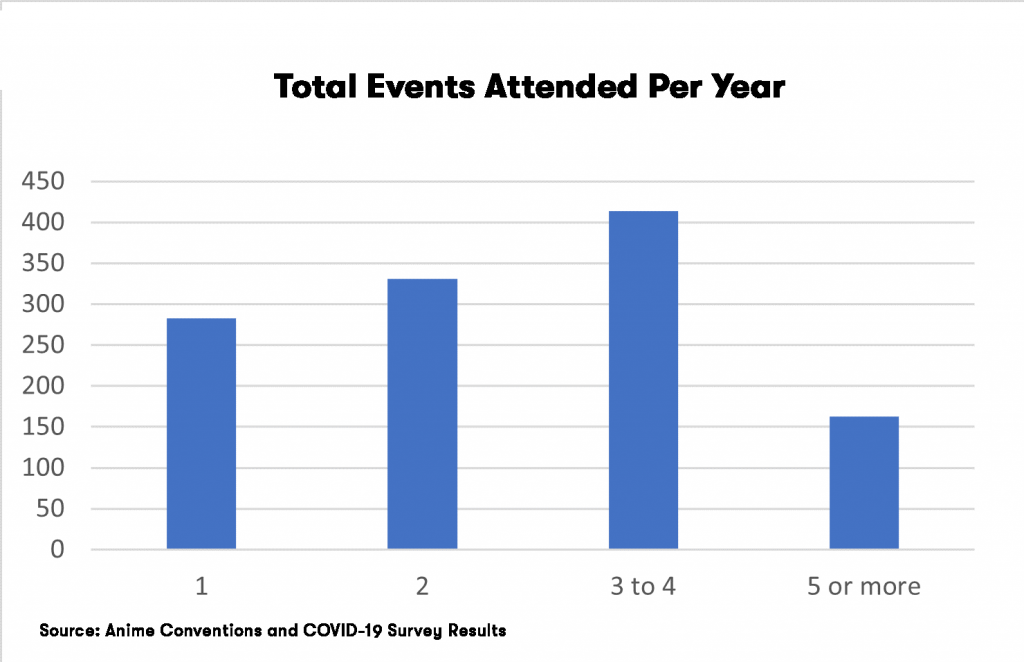
Attending at least 1 con and being 18 years of age or old were the only prerequisites for taking the survey. In terms of attendance, 23% of respondents (n 283) reported that they usually attended 1 con per year, while 28% (n 331) reported usually attending 2 cons per year, 34% (n 414) reported attending 3 or 4 cons a year, and 13% (n 13) reported attending 5 or more cons a year
Many also reported participating in specific roles, such as being con staff (n 129), running their own booths or events (n 127), or delivering talks on con panels (n 147).
Outlook on Attending Con Events
When asked about their outlook on returning to cons following the worst of the Covid-19 pandemic, most respondents were positive and excited. 62% (n 738) selected “I’m looking forward to attending conventions again” as their response, with 34% (n 413) reporting that “I’m conflicted – I am both looking forward to and worried about attending conventions again after COVID-19” and just 2% (n 26) reporting that “I’m not sure how I feel about attending conventions again after COVID-19.” In addition, 69% of respondents reported that the lack of cons in 2020-early 2021 affected their social lives to some degree: 34% of respondents (n 408) reported that the absence affected them “somewhat,” while a full 35% of respondents (n 418) said that this affected them “noticeably.”
It also seems that virtual cons did not completely fill this deficit. 63% of respondents (n 756) reported that they did not attend virtual cons during Covid-19, while fully 87% (n 1032) reported they did not attend in-person cons. Meanwhile, only 23% (n 233) of respondents reported trying to recreate the anime con experience through cosplaying outside of cons or attending virtual gatherings that weren’t either cons or con-organized. In addition, 77% (n 958) indicated that they did not attempt to recreate the con experience in other ways.
From the fact that many noted the absence of cons on the one hand, and then the way that the vast majority did not attend online cons or attempt to recreate this experience on the other, the researchers extrapolate that the majority of those who usually attend cons encountered significant difficulties or obstacles to recreating similar events virtually and/or on an individual basis. This seems particularly significant given how many participants reported being affected by the dearth of in-person cons.
Feedback on Event Safety Measures in the Future
Looking forward to cons reopening in late 2021 and on into 2022, respondents also had the opportunity to provide their thoughts on this reopening process. The survey offered an option for no concerns, a selection of 3 specific safety measures (sanitation requirements, limited attendance, mask requirements), and “Other,” a free space in which respondents had the option to describe any additional safety measures they hoped to see. The survey also enabled the selection of as many choices as respondents liked. Following these options, 81% of respondents (n 969) reported their support for some form of safety measures, and 62% (n 748) indicated interest in a combination of two or more safety measures. More specifically:
- 70% (n 842) indicated interest in accessible sanitation measures and sanitation requirements
- 53% (n 631) indicated interest in mask requirements
- 43% (n 511) indicated interest in limited attendance, i.e. smaller crowds
- 19% (n 237) selected “Other” and used this space to describe a range of preferences, including control/reduction of lines, face masks coming with badges/passes, enforcement of mask mandates, and vaccination requirements, among others
On this portion of the survey, only 18% (n 222) of respondents selected the option indicating that they preferred no safety measures. Then among this number, an even smaller but sometimes very vocal group used the “Other” space and other freeform answers across the survey to voice concerns and outright anger about vaccine requirements.
Having seen this, the researchers recommend awareness that, while pushback against safety precautions may be vocal, it seems to constitute a fairly small percentage of the total number of those seeking to attend cons as they reopen.
Thoughts on Future Directions
As work on this dataset continues, an expanded version of this report will begin quantifying respondents’ freeform responses and looking at how respondents described other activities, such as attending con events, cosplaying, attending panels, etc.

Billy Tringali (@BillyTringali) is the founder and editor-in-chief of JAMS: The Journal of Anime and Manga Studies (@OpenAccessAnime), the only open-access journal solely dedicated to publishing high-quality academic works regarding anime, manga, cosplay, and their fandoms. The journal’s first published volume is available at go.Illinois.edu/anime. Billy earned his MLIS from the University of Illinois at Urbana-Champaign and currently works as the Law Librarian for Outreach at Emory University School of Law.

Maria Alberto (@MariaKAlberto) is a PhD candidate at the University of Utah, where her work focuses on fans and their engagement with media texts, particularly pop culture ones. She has presented parts of her research at Akon and Fan Expo Denver, and she is also a manuscript reviewer for The Journal of Anime and Manga Studies. She earned her MA from Cleveland State University.
The post Data Available from Survey on Anime Conventions and Covid-19 appeared first on Project Anime.
]]>The post An Adventurous Shipper and a Princess Walk into a Hot Topic: The Art of Segmentation appeared first on Project Anime.
]]>Interpret has recently completed a segmentation of the anime market, organizing viewers into eight segments to reveal fundamental needs, attitudes, and behaviors common to the clusters within a diverse array of anime viewers. Of these eight, three possess a strong female-identifying skew, and we have coined shorthand terms for each: Princesses, Adventurous Shippers, and Hot Topics.
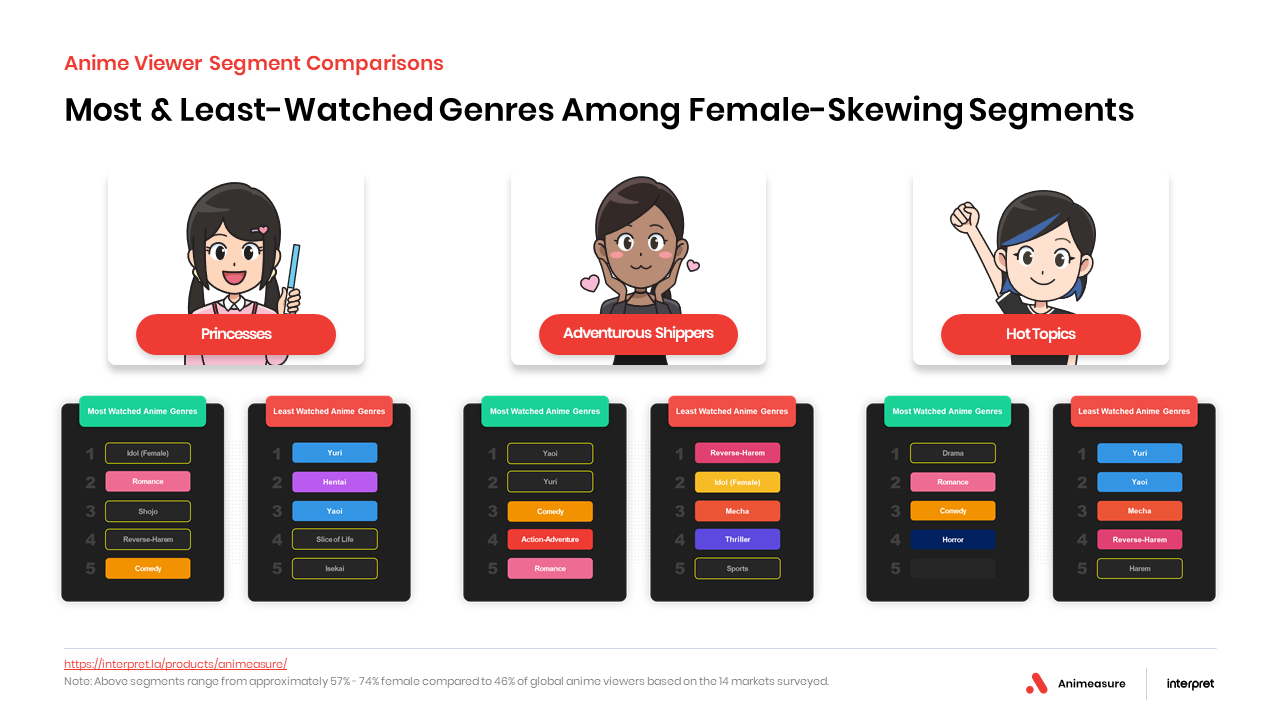
These three segments do not account for all female anime viewers, nor do they fully exclude male-identifying viewers. However, in comparing the viewing habits of these three segments, we realize the extraordinary diversity among female anime viewers who may, on the surface, hold much in common.
For example, all three female-dominated segments report a strong preference for Romance genre anime. When contextualized by their other reported genre preferences, it becomes apparent that the specific driver of this preference may differ dramatically by the segment.
The tongue-in-cheek ‘Princess’ segment is named for the viewer who sees herself as central to the narrative, embodied by a character or serenaded by the onscreen cast. This segment notably raves over Reverse-Harem series, as well as Female-oriented Idol anime featuring charismatic and attractive male leads.
By contrast, Princesses report a strong aversion to the most preferred genres of Adventurous Shippers: Yaoi (Boys’ Love) and Yuri (Girls’ Love). Though both groups overwhelmingly identify as female, we interpret this divergence as being rooted in more than a rejection or acceptance of homoromantic narratives. The Adventurous Shipper preference may be informed in part by a desire for narratives that highlight the relationships of others, without requiring the viewer to identify themselves as the subject of the characters’ affections.
Hot Topics bring a bit of edge to our warm and fuzzy dialogue, citing Romance alongside Drama, Comedy, and Horror as their favorite anime offerings. Unintuitive at first glance, we understand this segment of fans as drawn to powerful anime that elicit strong, cathartic feelings in the storied tradition of body genres (a theory from the world of cinema studies, courtesy of Linda Williams.)
As this analysis shows, the anime genres that segments eschew reveal as much as the genres that they prioritize. The Princess and and Hot Topic segments do not care for Yaoi and Yuri anime. Likewise, Reverse-Harem anime inspire similar disdain among Adventurous Shippers and Hot Topics, implying that neither of these segments neatly align with the Princess ideal. Horror is horrifying to the majority of Princess segment viewers, and elicits a lukewarm response from Adventurous Shippers, but Hot Topic segment viewers keep the heartthrobs, sobs, and screams coming in their entertainment queue, carving out a clear third space for female fandom.
Put another way, all three segments might have tuned in for the climactic final season of Fruits Basket— but while Princesses are cheering on Tohru and Kyo, Adventurous Shippers are tuning in for the non-canon pairings you might not have anticipated, and Hot Topic viewers are vibing with the narrative that combines romance, drama, comedy, and even (spoiler alert!) horror elements.
Perhaps you know someone who resembles one of these data-based profiles. What else might we learn from the viewing habits of a given segment? Which, if any, of these segments do you think best aligns with your anime viewing preferences? How do you conceptualize different segments in the anime audience?
To learn more about Interpret’s anime consumer insights offerings like Animeasure, you can visit our website at: https://interpret.la/products/animeasure/
The post An Adventurous Shipper and a Princess Walk into a Hot Topic: The Art of Segmentation appeared first on Project Anime.
]]>The post 5 Survey-Creation Tips from Anime Academics appeared first on Project Anime.
]]>There’s an art to surveys, though: we’ve all seen versions that we wouldn’t take unless we were being paid to, right? In fact, as the researchers behind the Survey of Anime Convention Attendance in Response to Covid-19, we went through our survey exhaustively to try and create something that people would remain interested in and excited to take.
And it’s seemed to work so far. Asking anime con-goers what they want to see from their favorite cons after a year – and in some cases, two! – away has netted us some fascinating insights about cosplay events and more.
While designing our own survey, we certainly looked to resources like industry leader SurveyMonkey’s 10 Best Practices For Creating Effective Surveys, but at the same time, they’re already experts. So what can people who *don’t* make surveys for a living do?
If you’re thinking of creating a survey for your own con-goers, here are some tips we’d recommend:
1. Have a goal in mind for the survey
In other words, what do you want to achieve with this? Do you just want to see how many attendees enjoyed your con, or do you want to know what they expect from a future event? Keep in mind what you want to know or understand better by sending people this survey, and that will help you figure out what kinds of questions to ask, too.
2. Have a plan for your survey results
Before your survey even goes out, make sure you know what you’ll do with what you find! Make sure you discuss who is in charge of storing data, where it will be stored, and who is the contact person who can answer questions about it.
3. Design your survey to accommodate the people taking it
Or, in other words, make your survey easy for people to take no matter how they’re coming to it. Is your survey accessible for respondents with visual impairments? Is it responsive on mobile devices like phones and tablets? Can your questions be answered using a keyboard *or* a touchscreen?
4. Create clear, straightforward questions
Are questions easy to understand? Just as important, are they hard to misinterpret? Does the survey use skip/display logic (i.e., questions that move people to a new survey page when they answer a question in certain ways) to make sure respondents are only seeing relevant questions?
5. Test your survey early and often
Your survey might seem intuitive to you when you’re creating it, but make sure that you try it out too, just to check! That way, you can catch missing links, navigation issues, and more, before you actually send it out to participants who will report back on those same issues. (Pew Research Center offers more tips on survey design, too!)
Ready to get started on your own survey? Here are some additional reads we’d recommend on survey methods and also on how to create a survey from scratch!
Billy Tringali (@BillyTringali) is the founder and editor-in-chief of JAMS: The Journal of Anime and Manga Studies (@OpenAccessAnime), the only open-access journal solely dedicated to publishing high-quality academic works regarding anime, manga, cosplay, and their fandoms. The journal’s first published volume is available at go.Illinois.edu/anime. Billy earned his MLIS from the University of Illinois at Urbana-Champaign and currently works as the Law Librarian for Outreach at Emory University School of Law.
Maria Alberto (@MariaKAlberto) is a PhD candidate at the University of Utah, where her work focuses on fans and their engagement with media texts, particularly pop culture ones. She has presented parts of her research at Akon and Fan Expo Denver, and she is also a manuscript reviewer for The Journal of Anime and Manga Studies. She earned her MA from Cleveland State University.
The post 5 Survey-Creation Tips from Anime Academics appeared first on Project Anime.
]]>The post Female Fandom & Anime: Uninterested or Underserved? appeared first on Project Anime.
]]>Of all 14 markets surveyed, the US has the smallest fraction of its Anime viewership that identifies as female. Some markets like Vietnam, Russia, and France even see female majorities. In several more, like Korea, China and India, there are nearly even splits.
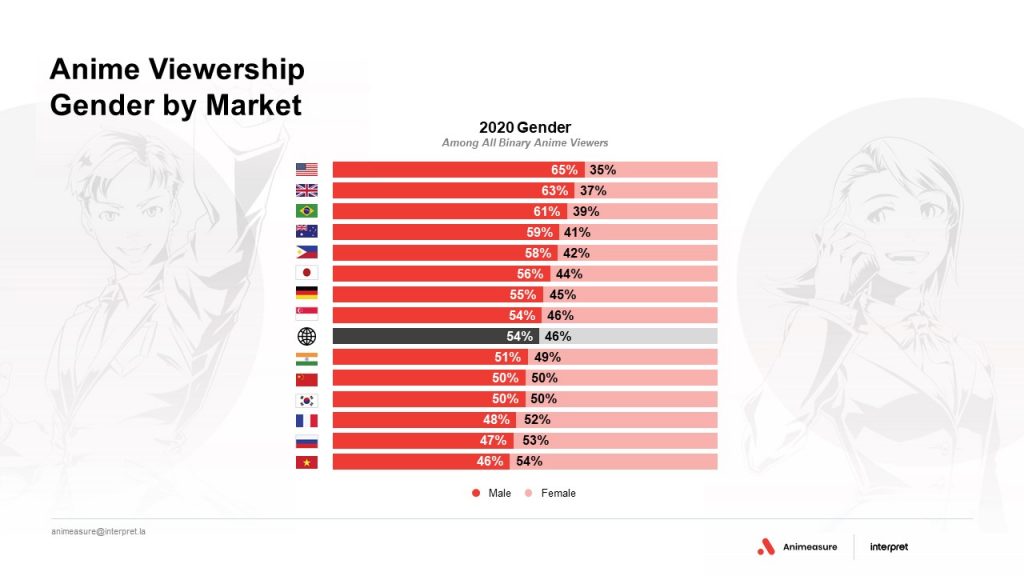
This gender breakdown would likely surprise those in the industry who gauge the anime fanbase at fan conventions. Female viewers consistently show up at conventions and live events, with 40-50% or more of convention attendees at many major anime fan conventions in the US identifying as female. Female viewers are engaged, valuable members of the core anime fandom, yet they do not see the same parity in the broader anime viewership, suggesting the American gender gap is greatest among a more casual, mainstream anime audience.
With such high female viewership in other comparable markets, it seems unlikely that anime appeals less to American women and more likely that there is an opportunity to serve and grow this market, a female market with diverse segments of its own.
What other audiences within the broader anime audience have untapped potential? Next month Interpret will continue to delve into how diverse the anime fandom can be.
The post Female Fandom & Anime: Uninterested or Underserved? appeared first on Project Anime.
]]>The post US Genre Preference: How Anime Meets Needs Not Met by Other Media appeared first on Project Anime.
]]>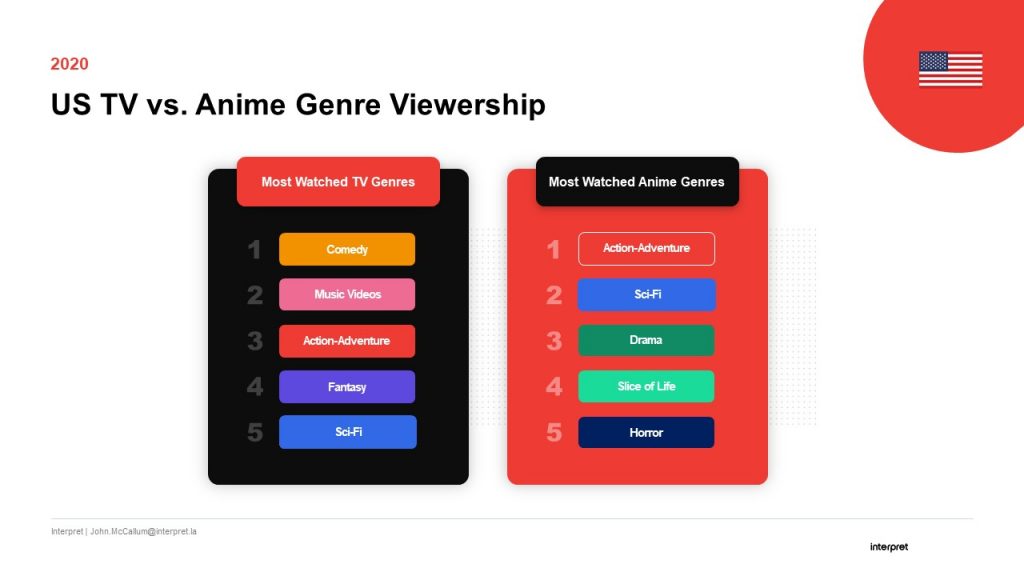
The US is the only market of 14 surveyed that did not rank Comedy in its Top 3 most watched anime genres. In fact, comedy is not even a Top 5 anime genre in the United States. This seems paradoxical—Comedy television among Americans enjoys enduring and overwhelming popularity – it is the #1 most watched TV genre. It would appear, then, that Americans prioritize anime to meet other viewing needs. Why is this the case? Could it be that Japanese comedy is too culturally-specific for American audiences?
That hypothesis, that Japanese comedy is too culturally-specific for an American audience, is suspect. When considering the United States, beyond Action-Adventure and Sci-Fi, the genres rounding out its Top 5 (i.e., Drama, Slice of Life, and Horror) can also be quite culturally specific to Japan. American viewers do not balk at Slice of Life simply because they do not have personal familiarity with every Japanese custom depicted. Then why don’t American anime viewers prefer Japanese comedy as much as viewers in other markets?
Perhaps Americans have a firmer expectation of what an animated comedy looks like. Context counts here. If a domestic market fails to meet a fundamental need, then an audience may be more inclined to look elsewhere to meet that need. But if that need is well-met, and the definition of ‘animated comedy’ has solidified, viewers may feel less inclined to be open to another market’s take on the genre. America is well-known as a producer of acclaimed, comedic animated series and movies – its audience may not feel the need to import them.
But how many America-originated, adult-oriented animated dramas are there? How common are cartoon Slice of Life series on Saturday mornings? When was the last time you watched an animated horror series? Examples that prove the rule exist (some of them inspired by anime), but these genres are rarely explored in Western animation. It suggests that, perhaps, US Anime Viewers are finding needs met in Japanese animation that are not being met currently in Western animation (or even live-action series). American anime viewers do not want for comedic animation, so they do not prioritize looking for it in anime, but if they want something with action, drama, or horror, then anime meets that need.
What are your favorite genres of anime, and how do they compare to your favorite genres of television more broadly? In our next blog post, we will continue thinking about how anime viewership converges with other aspects of entertainment with a focus on esports.
The post US Genre Preference: How Anime Meets Needs Not Met by Other Media appeared first on Project Anime.
]]>The post Why You May Not Know Your Anime Fans as Well as You Think appeared first on Project Anime.
]]>The vast majority of genres are mostly stable. For example, Comedy is a genre as old as time – and a genre that does not typically see a lot of growth or contraction among the many folks tuning in for a laugh each week. Even with COVID, we seem to maintain our sense of humor. So, a big, dominant genre like Comedy sees little movement.
A more niche genre, like Talk Shows might exhibit more volatility. For whatever reason, Talk Shows are down in 2020 compared to the same quarter in 2019.
But of all the genres we ask about, with most showing little change Year-Over-Year and a couple struggling, only one shows substantial and significant YOY growth: anime. There are two main takeaways from this.
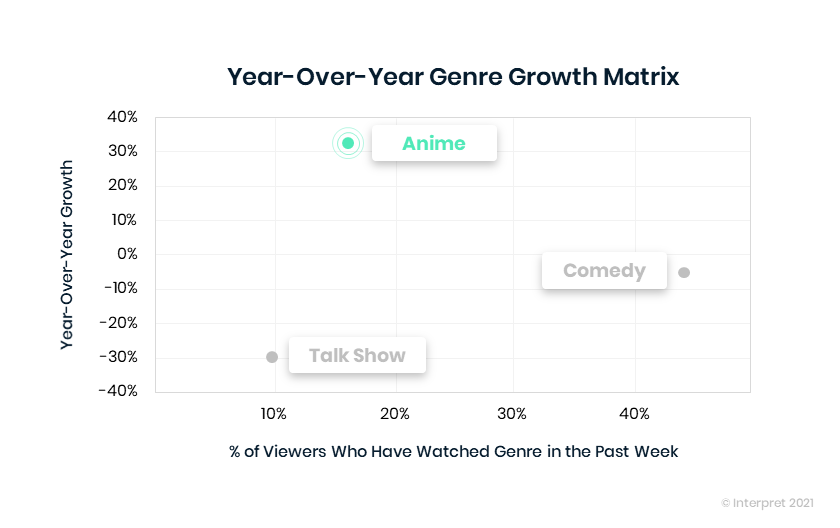
First of all, Anime is doing well here in the United States! Sure, it’s still niche. The greater than 30% growth Interpret sees does represent something like a change from 12% to 16% of US TV/streaming viewers aged 13-44 who watch it weekly. Netflix reports a 50% increase in households watching at least one anime title in 2020. Crunchyroll has added an additional 1 million paid subscribers in about 6 months. Anime is a rising star in the world of niche entertainment.
The second, and more striking, take-away is that fully one-quarter of people watching Anime today were not watching it a year ago. Put another way, if your understanding of the anime fandom is based on research or interactions from 5 years or 3 years or even a year ago, 25% of the Anime Fan population today is made up of people you may not yet know.
2020 has been a challenging year and 2021 has not taken its foot off the pedal yet, but much as the industry must change and grow, newcomers to this space are developing their preferences, viewing habits, and demand for programming in real time, and we should watch closely to see what kind of fan emerges from this rapid period of growth and innovation in fan lifestyles.
The anime fandom is not only rapidly growing, but globalizing. Next month, Interpret will draw on further insights from our 2020 global anime research to offer context for forming a global anime strategy and understanding how global trends impact each and every domestic market.
The post Why You May Not Know Your Anime Fans as Well as You Think appeared first on Project Anime.
]]>