The post Data Available from Survey on Anime Conventions and Covid-19 appeared first on Project Anime.
]]>Data analysis is ongoing by the researchers, Maria Alberto (Ph.D. candidate at the University of Utah) and Billy Tringali (Editor-in-Chief of the Journal of Anime and Manga Studies). A preliminary copy of the dataset itself is now available on Dropbox and also through the Hive, the University of Utah’s digital data repository. The following report provides some initial data points that may be of particular interest to con organizers, and the researchers are also completing a longer version that will include all data points.
Download Raw Data:
Important Disclaimer: Due to the researchers’ Institutional Review Board agreement with the University of Utah, the raw qualitative responses to the survey cannot be shared at this time. Because open-ended answers may provide personally identifiable information about the respondents, the raw data released only covers the raw quantitative data from this study to protect the identities of those that participated in this anonymous survey.
Who Answered the Survey
This survey collected 1,191 valid responses from respondents in the US (n 1112) and beyond (n 79). The majority of respondents, 53% (n 636), reported being 25-34 years of age, while 30% (n 361) reported being 18-24 years of age, 13% (n 149) reported being 35-44 years of age, 2% (n 25) reported being 45-54 years of age, 1.4% (n 17) reported being 55-64, and >0.3% (n 3) reported being 65 or above. These respondents reported attending 359 individual cons in 29 countries (primarily the US, Canada, Japan, Ireland, the Philippines, and the UK) and 49 of the 50 US states (all except Wyoming).
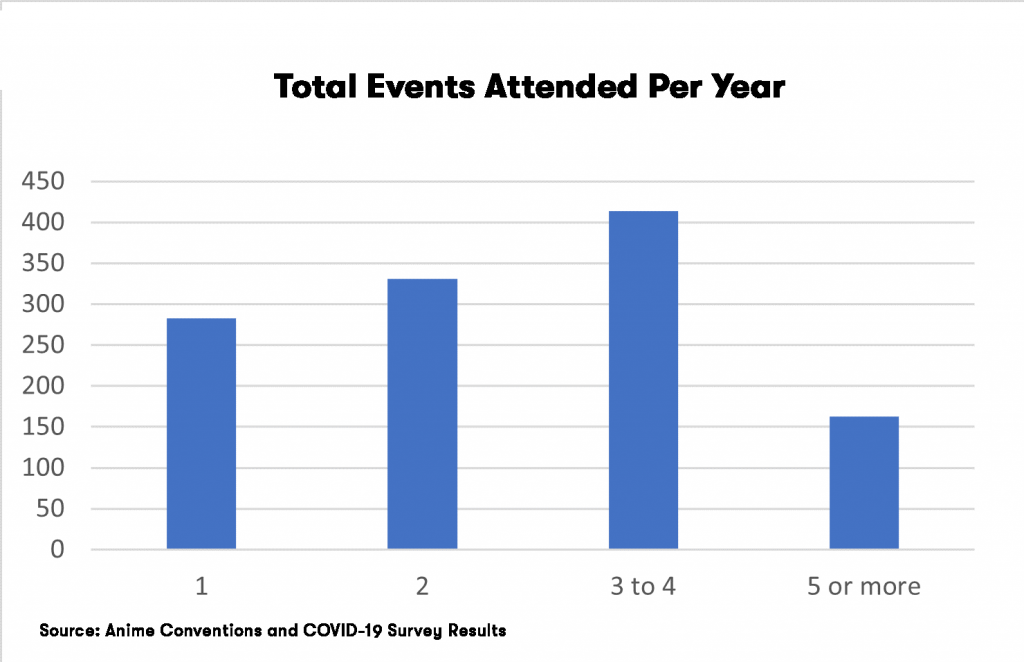
Attending at least 1 con and being 18 years of age or old were the only prerequisites for taking the survey. In terms of attendance, 23% of respondents (n 283) reported that they usually attended 1 con per year, while 28% (n 331) reported usually attending 2 cons per year, 34% (n 414) reported attending 3 or 4 cons a year, and 13% (n 13) reported attending 5 or more cons a year
Many also reported participating in specific roles, such as being con staff (n 129), running their own booths or events (n 127), or delivering talks on con panels (n 147).
Outlook on Attending Con Events
When asked about their outlook on returning to cons following the worst of the Covid-19 pandemic, most respondents were positive and excited. 62% (n 738) selected “I’m looking forward to attending conventions again” as their response, with 34% (n 413) reporting that “I’m conflicted – I am both looking forward to and worried about attending conventions again after COVID-19” and just 2% (n 26) reporting that “I’m not sure how I feel about attending conventions again after COVID-19.” In addition, 69% of respondents reported that the lack of cons in 2020-early 2021 affected their social lives to some degree: 34% of respondents (n 408) reported that the absence affected them “somewhat,” while a full 35% of respondents (n 418) said that this affected them “noticeably.”
It also seems that virtual cons did not completely fill this deficit. 63% of respondents (n 756) reported that they did not attend virtual cons during Covid-19, while fully 87% (n 1032) reported they did not attend in-person cons. Meanwhile, only 23% (n 233) of respondents reported trying to recreate the anime con experience through cosplaying outside of cons or attending virtual gatherings that weren’t either cons or con-organized. In addition, 77% (n 958) indicated that they did not attempt to recreate the con experience in other ways.
From the fact that many noted the absence of cons on the one hand, and then the way that the vast majority did not attend online cons or attempt to recreate this experience on the other, the researchers extrapolate that the majority of those who usually attend cons encountered significant difficulties or obstacles to recreating similar events virtually and/or on an individual basis. This seems particularly significant given how many participants reported being affected by the dearth of in-person cons.
Feedback on Event Safety Measures in the Future
Looking forward to cons reopening in late 2021 and on into 2022, respondents also had the opportunity to provide their thoughts on this reopening process. The survey offered an option for no concerns, a selection of 3 specific safety measures (sanitation requirements, limited attendance, mask requirements), and “Other,” a free space in which respondents had the option to describe any additional safety measures they hoped to see. The survey also enabled the selection of as many choices as respondents liked. Following these options, 81% of respondents (n 969) reported their support for some form of safety measures, and 62% (n 748) indicated interest in a combination of two or more safety measures. More specifically:
- 70% (n 842) indicated interest in accessible sanitation measures and sanitation requirements
- 53% (n 631) indicated interest in mask requirements
- 43% (n 511) indicated interest in limited attendance, i.e. smaller crowds
- 19% (n 237) selected “Other” and used this space to describe a range of preferences, including control/reduction of lines, face masks coming with badges/passes, enforcement of mask mandates, and vaccination requirements, among others
On this portion of the survey, only 18% (n 222) of respondents selected the option indicating that they preferred no safety measures. Then among this number, an even smaller but sometimes very vocal group used the “Other” space and other freeform answers across the survey to voice concerns and outright anger about vaccine requirements.
Having seen this, the researchers recommend awareness that, while pushback against safety precautions may be vocal, it seems to constitute a fairly small percentage of the total number of those seeking to attend cons as they reopen.
Thoughts on Future Directions
As work on this dataset continues, an expanded version of this report will begin quantifying respondents’ freeform responses and looking at how respondents described other activities, such as attending con events, cosplaying, attending panels, etc.
Billy Tringali (@BillyTringali) is the founder and editor-in-chief of JAMS: The Journal of Anime and Manga Studies (@OpenAccessAnime), the only open-access journal solely dedicated to publishing high-quality academic works regarding anime, manga, cosplay, and their fandoms. The journal’s first published volume is available at go.Illinois.edu/anime. Billy earned his MLIS from the University of Illinois at Urbana-Champaign and currently works as the Law Librarian for Outreach at Emory University School of Law.
Maria Alberto (@MariaKAlberto) is a PhD candidate at the University of Utah, where her work focuses on fans and their engagement with media texts, particularly pop culture ones. She has presented parts of her research at Akon and Fan Expo Denver, and she is also a manuscript reviewer for The Journal of Anime and Manga Studies. She earned her MA from Cleveland State University.
The post Data Available from Survey on Anime Conventions and Covid-19 appeared first on Project Anime.
]]>The post Understanding Your Rights as an Artist: Contracts & Copyright appeared first on Project Anime.
]]>To get involved in comic book law, Hennessy recommends understanding contract law, intellectual property law (specifically copyrights and trademarks), entertainment law (such as service agreements in studios and distribution agreements), and lastly publishing law.
When it comes to protecting your work as an artist, it is important to understand what is and is not your work. “A lot of times people are creating art that they do not necessarily own,” which includes creating art based on other characters owned by other companies or making art in a work-for-hire situation.
Once you have determined the art is indeed your original work, there are three basic steps to protect your art:
- Memorialize: Registering a copyright for your original work with the US Copyright Office to memorialize the fact that you are in fact the owner
- Retain Ownership: Whenever working with other entities, it is important that the contract states that you retain ownership of the copyright in the contracts.
- Monitor and Enforce: When you see your art used on another platform without your permission, you can send a cease and desist letter or DMCA takedown notice to enforce your ownership of your copyright.
Hennessy also discussed the differences between trademarks and copyright and what to look out for when it comes to contracts. Check out the full panel above to learn more.
For more resources and to learn more about Gamal Hennessy’s services, please visit his website.
To learn more about Kuo-Yu Liang, visit kuworldwide.com
The post Understanding Your Rights as an Artist: Contracts & Copyright appeared first on Project Anime.
]]>